Not every 3D scanning company is built for high-stakes work. For a hobbyist scanning a figurine, accuracy within a millimeter is fine. However if you’re reverse engineering a legacy aerospace component, validating a machined part against its CAD model, or capturing complex geometry for reproduction, you need a company that operates at a different level entirely.
The problem is that most vendors present well on paper. They all claim accuracy, experience, and fast turnaround. Here’s how to actually separate the ones who can deliver from those who can’t.
Demand Specifics on Accuracy, Not Just a Number
When looking on how to choose a 3d scanning company, each vendor will quote you an accuracy figure. What they won’t always tell you is that the number on the spec sheet is measured under ideal lab conditions. These conditions include stable temperature, controlled lighting, stationary target. Real-world results on reflective titanium parts, large structural assemblies, or complex curved surfaces can be a different story.
When evaluating a vendor, ask:
- What scanner hardware do you use, and what is its certified accuracy rating?
- How does that accuracy hold up on parts similar in size and material to mine?
- Do you use photogrammetry for large-format work, and when do you apply it?
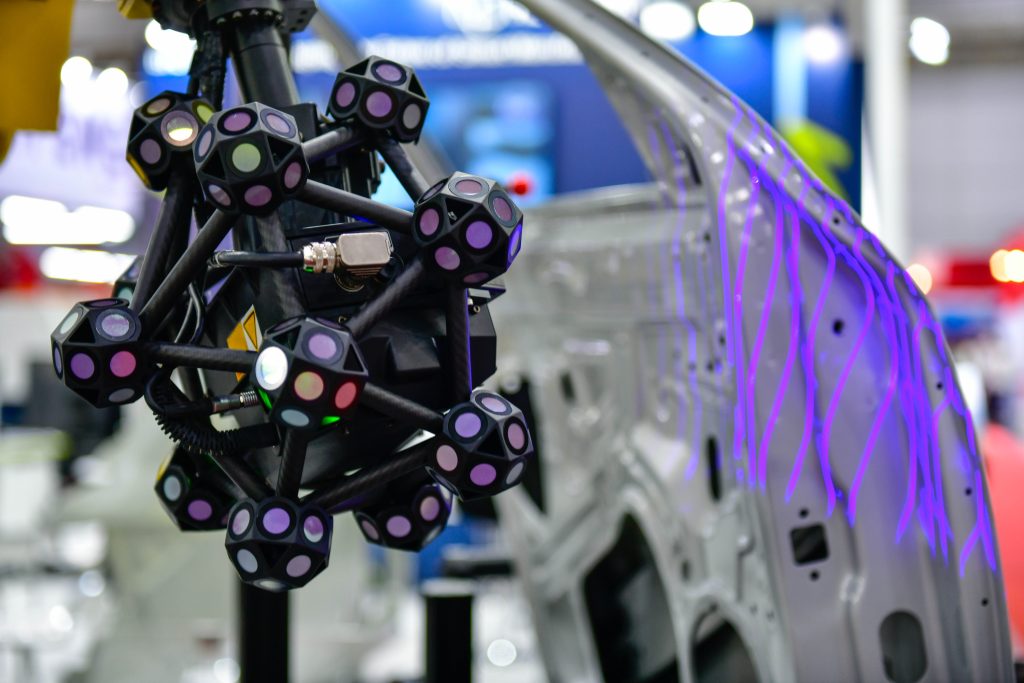
For most aerospace, automotive, and precision manufacturing applications, metrology-grade laser scanning should deliver accuracy to 0.02mm or better. If a vendor can’t walk you through how they achieve that on your specific type of part, that’s your answer.
There’s also a difference between accuracy and resolution. Accuracy is how close the scan data is to the true geometry. Resolution is how much surface detail the scanner captures. Both matter for high-precision work and a scanner can be accurate but miss fine surface features, or capture high-resolution data that drifts in overall accuracy across a large part. Ask about both.
At Tangent Solutions, our equipment delivers accuracy down to 0.02mm. We’re transparent about which scanner is right for which job because not every project needs the same tool or level of accuracy.
How to Choose a 3D Scanning Company for Mobile Work
High-precision projects often involve parts that can’t leave the facility. A large structural assembly bolted to the floor, components mid-production on the line, or fixture that’s part of a larger system. Shipping isn’t always an option and even when it is, transit introduces risk for delicate parts.
Some of the best 3D scanning companies operate with fully mobile, on-site capability. This isn’t a premium add-on. It’s a core requirement for any vendor doing real industrial work.
Ask whether they have portable scanning equipment and experience in active manufacturing environments, not just a clean studio. Ask if they’ve worked in environments with vibration, ambient light variation, or large working volumes. A vendor who has only ever scanned in controlled conditions will struggle the moment they step onto a production floor.
On-site scanning also gives you the ability to catch problems in real time. If the first scan pass reveals a surface issue or an unexpected geometry, the engineer is standing right there to adjust the setup, not emailing you three days later asking for the part back.
Tangent Solutions technicians can provide mobile 3D scanning services. We bring the equipment to your facility, work around your schedule, and capture the data where the parts actually live. See how we put this into practice in our case study on large-format on-site scanning for Bayliss Machine & Welding.
What Files You’ll Receive at the End
A point cloud is raw data. It’s a starting point, not a deliverable. For high-precision work, what you need is a finished, actionable file and the format matters depending on what you’re doing with it.
Common deliverables for precision projects:
- STEP or IGES : the standard for reverse engineering, CNC machining, and part reproduction
- STL : for additive manufacturing, FEA analysis, or rapid prototyping
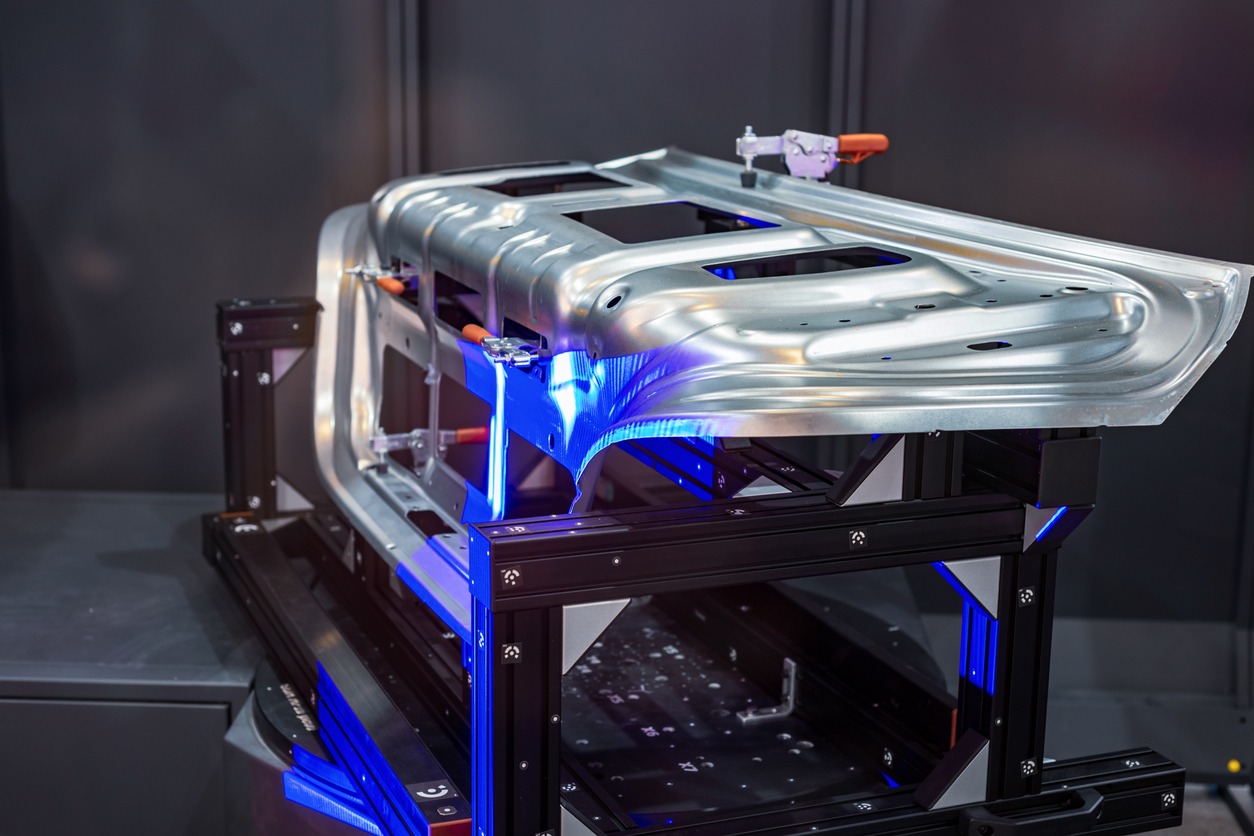
- Deviation analysis / inspection report : a color-mapped comparison of as-built geometry against the original CAD model, used for quality control and compliance documentation
On that last point: not all inspection reports are equal. A thorough deviation analysis will include a full color map of the part surface showing where geometry falls within tolerance and where it doesn’t, along with callouts for critical features and a clear summary of pass/fail status. A bare-minimum report is often just a PDF with a few measurements and no visual context. If your project involves compliance documentation or sign-off by an engineering team, confirm upfront what the report actually includes.
The key question is whether the vendor handles the full scan-to-CAD workflow in-house. Many companies capture the scan data and then outsource the reverse engineering or CAD modeling to a third party. That introduces delays, communication gaps, and inconsistency in the final output. When something needs to be corrected, you’re waiting on a chain of people instead of one team that owns the whole project.
Tangent Solution handles everything in-house, from scanning through reverse engineering, so there’s a single point of accountability from start to finish. Our sample folder of most common deliverables can help you understand the issue of each file type and what best suits your project needs.
Look for Industry-Specific Experience, Not Just General Scanning
There’s a difference between a company that has scanned 200 industrial parts and one that has specifically worked in your industry. Aerospace tolerances are different from automotive. Medical device requirements are different from consumer product development. The equipment, workflows, and attention to detail required are not the same.
In aerospace specifically, this matters more than almost anywhere else. Aerospace components often involve complex compound curves, tight GD&T requirements, and materials like carbon fiber or titanium that can be challenging to scan accurately without the right technique. A vendor experienced in aerospace knows how to handle reflective surfaces, how to set up photogrammetry for large assemblies, and how to structure deliverables that meet the expectations of an engineering review. One who isn’t will figure it out on your project and you’ll pay for that learning curve in time and rework.
Ask for work samples or case studies in your specific industry. Look at their client list. A company that has delivered for aerospace OEMs, Tier 1 suppliers, or precision manufacturers has already solved the problems you’re likely to bring them.
Tangent Solutions has worked with organizations including Alliance Aerospace Group, ADC Aerospace, Cyber Aerospace Corp, Archer Aviation, and PPG across applications from legacy part reverse engineering to complex structural inspection.
Evaluate Turnaround Times
In precision manufacturing, delays are expensive. A stalled production line waiting on a CAD file costs real money. A vendor that quotes a turnaround time should be able to back it up consistently, not just when the project is simple.
Ask about their current capacity and typical turnaround for a project like yours. Ask what their process is when something unexpected comes up mid-scan, a surface that’s difficult to capture, a geometry that requires additional setups. The answer will tell you a lot about how experienced they actually are.
For most projects, Tangents Solutions can turn-around scan and CAD files in 5 to 7 business days.
Verify That the Quote Matches What You Actually Need
This one catches people off guard. A low quote often means the scope has been stripped down a point cloud delivery with no reverse engineering, or a single scan position that won’t cover the full part geometry. By the time you ask for revisions or additional deliverables, the cost has exceeded what a full-service vendor would have charged upfront.
Before signing off on a quote, confirm:
- Is full CAD modeling included, or just raw scan data?
- Does the price include on-site travel, or is that billed separately?
- How are revision requests or scope changes handled?
Transparency at the quote stage is a reliable indicator of how the project will run overall.
Questions to Ask Before You Hire Any 3D Scanning Company
Before you commit, run through this list with any vendor you’re seriously considering. Their answers and how confidently they give them will tell you what you need to know.
- What scanner do you use and what is its rated accuracy? A knowledgeable vendor answers this immediately and can explain why that scanner suits your project.
- Have you scanned parts like mine before? Ask for examples. If they can’t show you similar work, that’s a risk.
- Do you handle CAD modeling in-house? If not, find out who does it and what the handoff process looks like.
- What file formats do you deliver, and can I request a specific format? The answer should be yes, with no hesitation.
- What is your standard turnaround, and what happens if a revision is needed? You want a clear answer, not “it depends.”
- Can you come to our facility? For anything large, sensitive, or mid-production, on-site is essential.
- What does your inspection report include? If they can’t describe it in detail, it probably isn’t very detailed.
A vendor who answers all of these confidently, with specifics, is one worth working with. Vague answers, deflection, or over-reliance on sales language are red flags.
The Bottom Line
Choosing a 3D scanning company for high-precision work comes down to verified accuracy, genuine on-site capability, in-house CAD expertise, and a track record in your industry. The lowest quote is rarely the right choice. The right vendor makes your project move faster, not slower and gets it right the first time.
If you’re working on an aerospace, automotive, or precision manufacturing project and want to talk through what you need, contact Tangent Solutions for a free estimate. We’ll tell you exactly what’s required and what you’ll get.